
In modern manufacturing, controlling production expenses without compromising product quality is a major priority for every industry. Heat processes are significant in metalwork, vehicle manufacturing, engineering and other industrial production processes. Without the use of traditional heating methods, these can be wasteful in terms of energy usage, longer processing times and the wasting of material. This is where induction heating machine manufacturers come in. These systems can lead to more efficient production times, delicate temperature control, and rapid processing processes by inducing direct heating within metal components via the phenomenon of electromagnetic energy. Knowing what goes into this kind of technology can assist manufacturers in making smarter investments in equipment and also control their running costs.
Let’s dive into this blog to explore 7 effective ways induction heating machines help reduce industrial production costs while improving energy efficiency, production speed, and overall manufacturing quality.
Smarter heating technology leads to better productivity and lower production expenses.
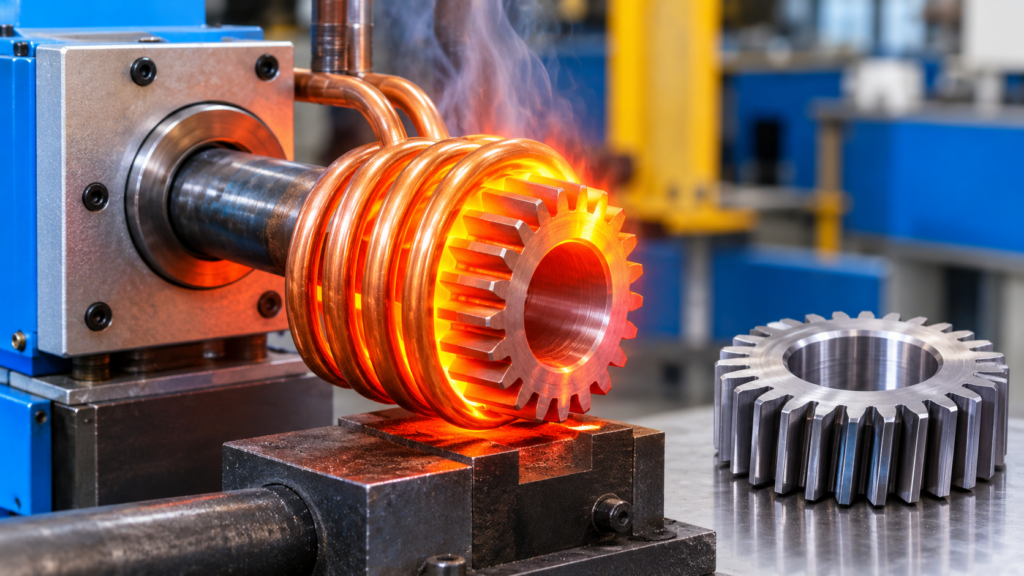
Energy expenses account for a considerable portion of industrial operating costs. Conventional heating systems often transfer heat through external sources, which can result in energy loss before the material reaches the required temperature. Induction heating follows a different approach. It uses an electromagnetic field to generate heat directly inside electrically conductive materials. Since the component itself produces the heat, the process can reduce unnecessary energy transfer.
Some important advantages include:
Targeted heating: Energy is concentrated on the required area instead of heating the entire surrounding space.
Reduced heat loss: Less energy escapes into the working environment.
Faster temperature rise: Metal components can reach their required processing temperatures more quickly.
Better energy management: Operators can control heating cycles according to specific production requirements.
Production delays have the potential to impact delivery dates, labour utilisation, manufacturing costs, and more. Excessive heating time can have repercussions on other processes too. Industrial induction heating equipment is able to overcome this problem by using the process of fast and controlled heat generation. Induction equipment does not require as long a warm-up time as similar conventional systems. In metal processing, a manufacturer can only appreciate the impact that it has on its overall output if he sees such small improvements in each individual step of the process, particularly the heating parts of the process.
This can improve productivity in several ways:
In industrial heating, it is vital to operate correctly at exactly the right temperature. Extremely high temperatures may cause damage to components, cause material property changes, or cause dimensional inconsistency. On the other hand, under-heating will result in under-processed products and rejections. Induction heating systems provide controlled heating that aids the operators in maintaining temperatures and providing the desired heating pattern. Some metal part that needs to be hardened on the surface but has a tougher core. With an appropriate quenching process, it may be possible to obtain the desired metallurgical effects by concentrating heat near the surface using controlled induction heating. Improvements in process control can minimise the number of rejected components, rework and raw material losses. This directly contributes to efficient manufacturing operations.
Manufacturers can modify according to machine design:
Equipment maintenance is another important factor that influences industrial production costs. The cost for the manufacturer can be significantly raised by machines that need to be serviced often, replaced, or shut down for long periods of time. Modern induction heating equipment consists of components including a power supply, induction coils, a control panel and a cooling system.
It has different maintenance requirements according to the different machine setup, operating environments and the intensity of production. Either that or well-designed and well-maintained systems can help manufacturers control the cost of equipment. Certain inspections, cooling water quality, electrical systems, and regular servicing are still important. Reliability in providing spare parts and technical support is also an important factor for consideration by the manufacturers before they buy equipment.
Manual heating processes frequently need constant attention from the operator for tracking temperature, heating time and component positioning. These activities can have an impact, increasing the labour requirement, especially in a high-volume manufacturing unit. Several of these responsibilities are made easier by automated induction heating systems, which have a programmable system to simplify the operating procedure and repeatable temperature settings. By letting operators devote less time to performing repetitive adjustments and more time to overseeing production quality, equipment operation, and process safety, automation frees up their time.
Automation can support production teams through:
The relationship between product quality and production costs is close. When components fail to meet manufacturing specifications, businesses may need to spend additional money on inspection, reprocessing, replacement, or rejected orders. Controlled and repeatable heating conditions allow induction heating to contribute to optimising the consistency of production batches, if the process is well developed. This will help minimise process variation, ensuring that the production of the product is reliable and that manufacturers do not incur costs from repeated manufacturing mistakes.
It comes in handy for the following applications, among others:
Surface hardening: Improves the wear resistance of selected metal surfaces.
Brazing: Helps heat-join areas without unnecessarily heating the entire assembly.
Annealing: Supports controlled heating for changing material properties.
Forging: Brings metal components to suitable temperatures for shaping.
Shrink fitting: Expands metal parts through heating to assist assembly operations.
Industrial expenses are also influenced by the working environment. Most fuel-fired methods of heating can generate combustion emissions, heat load, and ventilation needs. Induction heating uses electromagnetic energy to produce heat at the heating location as opposed to direct combustion of fuel at the heating location.
This can help to ensure a safer work area around the equipment. These benefits can be used to enhance working conditions in industries and to mitigate some of the environmental management costs. However, the overall environmental impact depends on electricity generation, machine efficiency, cooling requirements, and the complete manufacturing process. However, there is still a need for proper ventilation, electrical precautions, cooling, etc.
Other operating benefits are the following:
Investing in the right industrial technology is an investment in long-term operational efficiency.
Cutting manufacturing costs demands a lot more than just the low cost of manufacturing equipment. Businesses need to make sure they get the most energy usage, increase production speed, use material efficiently, maintain it, and ensure product consistency. When the technology is selected and operated wisely, induction technology offers a number of benefits in each of these areas. Depending on the specific application, the optimal induction heating machines manufacturers achieve more efficient production systems and manage lower operating costs. Knowing what features machines have, how they can be used, and how to access their technical support will ensure that businesses make an investment that can benefit their productivity and cost control.
They can reduce energy losses, shorten heating cycles, improve temperature control, minimise material waste, and support automated production. The actual savings depend on the application and operating conditions.
Automotive, aerospace, engineering, metal fabrication, electrical manufacturing, construction equipment, and heavy machinery industries commonly use induction heating for different metal processing applications.
They can be more energy-efficient in suitable applications because heat is generated directly within the conductive workpiece. However, actual efficiency depends on machine design, material properties, heating requirements, and operating conditions.
Induction heating is primarily used for electrically conductive materials such as steel, iron, copper, brass, and aluminium. Heating performance varies depending on electrical and magnetic properties.
Machine power, operating frequency, automation level, induction coil design, cooling arrangements, customisation, and production capacity can influence the overall equipment cost.
Your best partner for all your induction heating needs like Hardening, Tempering, Annealing, Brazing, Forming, Shrink fitting, Curing etc


