
“Consistent cooling helps maintain the performance of industrial heat treatment systems.”
What happens after a metal component reaches its required hardening temperature? The heating stage is only one part of the induction hardening process. Controlled cooling plays an equally important role in determining the final properties of a treated component. Without a suitable cooling arrangement, achieving consistent hardness, dimensional stability, and reliable surface properties can become challenging. Experienced induction hardening machine manufacturers consider cooling requirements while designing industrial hardening systems to support controlled processing and consistent treatment results.
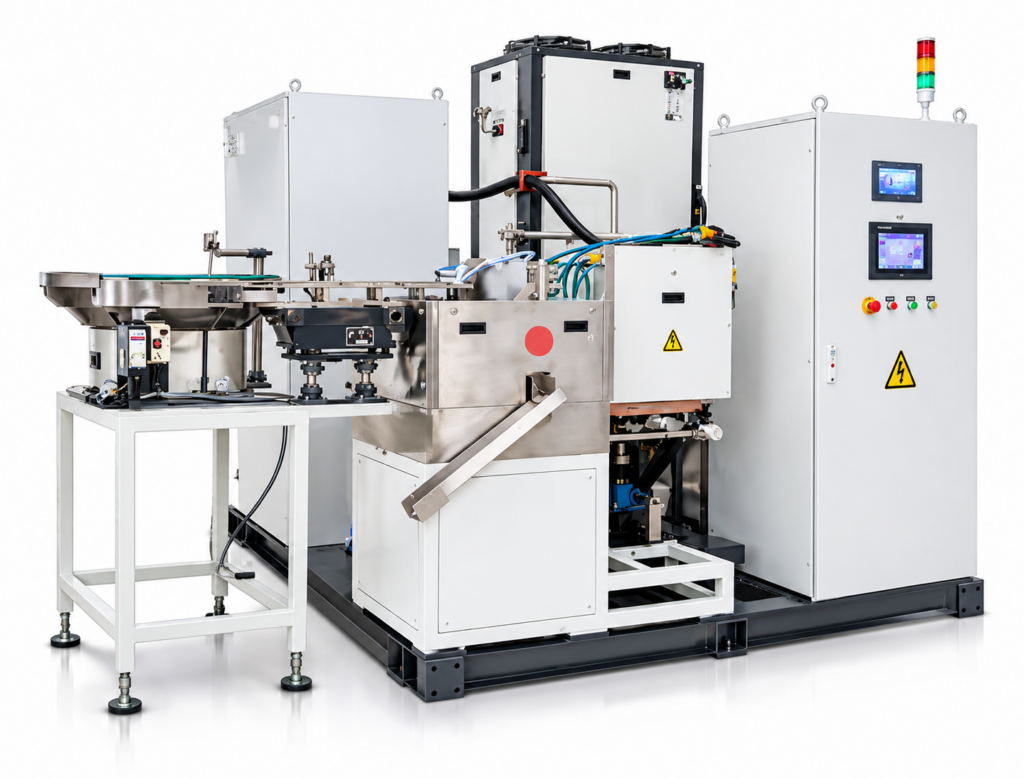
The cooling rate affects the transformation of heated metal in the hardening process. Once the material has been austenitised to the desired temperature, controlled quenching can be used to ensure the desired surface hardness is obtained in appropriate steel materials. Cooling system should be chosen based on the material type, component dimensions and depth of treatment desired. Good temperature control is also important for manufacturers to obtain repeatable production results.
Rapid heating and controlled quenching is a common method in induction hardening to obtain martensitic transformation in appropriate steels. On heating, the desired surface area is heated to the desired austenitising temperature. Then the heated area is rapidly cooled, promoting the conversion of the heated area into a harder martensitic structure. The material composition, component geometry and treatment specifications then require appropriate quenching conditions for the cooling system.
The following aspects are supported by a suitable cooling arrangement;
Thermal stresses may be generated in metal components due to the rapid change of the temperature. If the heated surface cools at a faster rate than the surrounding surface, temperature and thermal contraction differences may occur. Unless these conditions are controlled, they may lead to cracking, distortion, or residual stresses. These thermal effects can be controlled by using an appropriate cooling system that is selected by the material, geometry and heat treatment requirements of the component.
Things to take into account when cooling:
Industrial components need to be of exact size for them to fit in machinery and mechanical assemblies. The dimensional changes, no matter how small, can impact the functioning of gears, shafts, bearings and other mechanical components following treatment. Rapid and/or differential cooling can cause dimensional variations, especially when the component is complicated. These changes can be controlled and the dimensional specifications of treated parts can be met by proper cooling arrangements.
Cooling systems help to control dimensions by:
The overall cycle time of induction hardening operations is affected by cooling arrangements. A properly designed system can be used to remove excess heat from treated parts and can prepare the parts for subsequent manufacturing processes. A well-designed cooling system ensures that all parts are cooled quickly and reliably, which can improve the workflow in production. The cooling system should also be able to meet the operational demands of the machine without any unnecessary downtime.
Production-related advantages include:
Induction heating is employed in various industrial applications such as shafts, gears, bearings, crankshafts, automotive parts and more. The components are different thicknesses, geometries, surface areas and have different hardness requirements, which translates to different cooling requirements. Cooling methods may be effective for a small cylindrical part, but not the same for a larger or more irregularly shaped part. So, the characteristics of each component and application need to be taken into account in the design of cooling systems.
Consider the following factors in design:
The cooling medium condition of a quenching system is also an important factor in the performance of the system. Depending on material and process requirements, other suitable cooling solutions such as water based solutions and polymer quenchants are possible. Temperature, concentration and cleanliness of fluids may affect cooling ability. Routine monitoring can provide stable operating conditions and maintain consistent heat treatment results.
Regular cooling medium management involves:
Cooling is an essential part of achieving the required results in induction hardening. From controlling quenching rates and supporting metallurgical transformations to maintaining dimensional accuracy and protecting machine components, every cooling parameter contributes to the overall process. Businesses should consider cooling capacity, fluid circulation, temperature monitoring, component specifications, and maintenance requirements when evaluating industrial heat treatment equipment. Working with experienced Induction Hardening Machine Manufacturers helps industries identify suitable heating and cooling configurations based on material properties, component geometry, and production requirements. A properly designed system supports controlled processing, consistent treatment quality, and dependable industrial performance.
A cooling system helps control the quenching process after induction heating. It supports the required metallurgical transformation, surface hardness, and dimensional stability of suitable metal components.
Water-based solutions, polymer quenchants, and other specialised cooling fluids may be used depending on the material, component geometry, and required hardening specifications.
Yes. Inadequate or uneven cooling can result in inconsistent hardness, unwanted residual stresses, cracking, or dimensional distortion.
Cooling arrangements help remove excess heat from induction coils, power electronics, and other heat-generating components. This supports stable machine operation and protects sensitive equipment parts.
Maintenance frequency depends on machine usage and manufacturer recommendations. Regularly checking fluid levels, temperature, circulation, filters, pumps, and connections helps maintain reliable cooling performance.
Your best partner for all your induction heating needs like Hardening, Tempering, Annealing, Brazing, Forming, Shrink fitting, Curing etc


